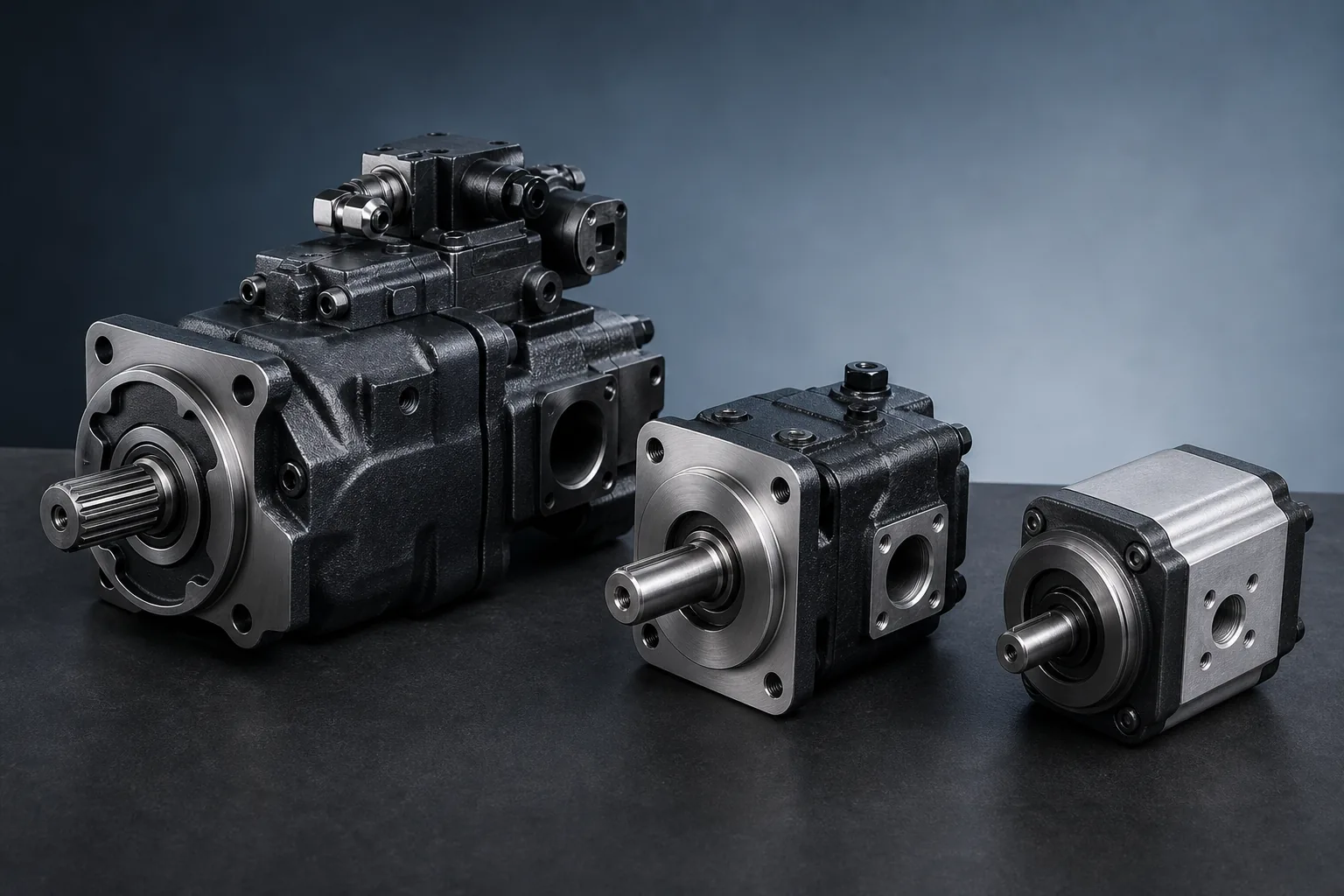
Sourcing a hydraulic pump from China is not the same as ordering a commodity part. Piston, vane and gear pumps carry configuration details — displacement, control type, rotation, shaft, flange, port orientation and through-drive — that must be verified before a quotation becomes a purchase order. This guide walks through the process from model identification to shipment release.
Send a hydraulic component for review: Include the complete model code, quantity, destination and available photos or drawings.
1. Start with the complete pump identity, not a family name
An A10VSO or PVH series label alone is not a purchase specification. The full model code defines the build that must be sourced.
- Record the complete model code including all suffixes, slashes and revision markers
- Photograph the nameplate straight-on in good light — every character must be readable
- Capture the serial number and order number separately
- Photograph the shaft end, mounting flange, port side and control/compensator assembly
- Note the machine manufacturer, model and year
2. Separate the code into review groups
A pump model code encodes displacement, control, rotation, shaft, flange, ports and options. Each group must be compared, not assumed.
| Code group | What it controls | Risk if omitted |
|---|---|---|
| Frame size / displacement | Theoretical flow, speed range and power demand | Wrong capacity — too little flow or excessive power draw |
| Control / compensator | Pressure regulation, load sensing, torque limiting or electronic control behaviour | Machine response changes; safety or cycle-time problems |
| Rotation | Pumping direction viewed from the drive shaft | Immediate damage on startup if reversed |
| Shaft and flange | Mechanical fit, pilot diameter, bolt pattern and spline/key details | Installation blocked or coupling mismatch |
| Ports and case drain | Main connections, case-drain routing and orientation | Hose conflict, incorrect case pressure or leakage |
| Through-drive / auxiliary | Rear-mounted auxiliary pump interface | Missing auxiliary function; system incomplete |
3. Supplier screening — beyond the marketplace listing
A pump supplier should be screened on identity, capability and order-specific evidence, not only on a catalogue page.
- Request the supplier's legal business name, registration and product scope
- Ask which pump families they produce or trade regularly — not 'all types'
- Request a sample quotation for the exact model code, not a similar series
- Check whether the supplier can provide dimensional confirmation before shipment
- Ask about test availability: what method, what equipment and whether the record is order-linked
- Confirm corrective-action process: what happens if a unit fails incoming inspection?
A supplier that cannot answer configuration-specific questions should be treated as a lead, not yet an approved source.
4. Technical comparison before purchase
The core of responsible sourcing: comparing the original pump specification against the proposed option.
- Displacement (cm³/rev) and permissible speed range
- Nominal and peak pressure rating
- Control type and setting range — confirm the compensator or regulator behaviour
- Rotation direction — confirm the manufacturer's viewing convention
- Mounting flange standard, pilot diameter, bolt pattern
- Shaft type, dimensions, spline or keyway specification
- Main port size, type, thread and orientation
- Case-drain port size and required routing
- Through-drive or auxiliary pump interface, if applicable
- Seal material and fluid compatibility (NBR, FKM, temperature range)
Record every confirmed point and every open item. Hidden differences are the most expensive kind.
5. Pre-shipment evidence — agree scope before payment
A useful pre-shipment check answers the question the buyer actually faces: 'Is this the unit I approved, and is it ready to install?'
- Identity: model code, nameplate and quantity matched to the order
- Dimensions: agreed mounting, shaft, flange and port points recorded
- Visual: casting, machining, port protection and overall condition
- Functional: test data only when the method, equipment, conditions and acceptance limits are stated in the quotation
- Packing: shaft and port protection, labelling and crate/pallet condition
Ask for the specific evidence you need in the RFQ. Availability and cost are confirmed before order placement.
6. Receiving, commissioning and record retention
- Inspect the pump on arrival: model, nameplate, dimensions, ports, rotation marking and visible condition
- Compare against the approved quotation and any pre-shipment records
- Commission at reduced pressure and speed where possible; monitor case-drain flow, noise, temperature and response
- Keep the complete RFQ, quotation, order, shipping and receiving records together
- For repeat orders, recheck the supplier, revision, material and application conditions — do not assume the last order governs the next one
Related Articles
Chinese Aftermarket Hydraulic Parts vs OEM: A Data-Driven Comparison
Compare Chinese aftermarket, OEM and remanufactured hydraulic component sourcing routes. Covers cost, lead time, quality evidence, warranty and when each route makes sense.
Read article →Pre-Shipment Inspection Checklist for Hydraulic Components from China
A practical pre-shipment inspection checklist for hydraulic valves, pumps, cylinders and motors sourced from China. Covers identity, dimensions, function, packing and documentation.
Read article →