Pump identification starts with a complete nameplate, but mechanical details and application data are often needed to confirm the exact build.
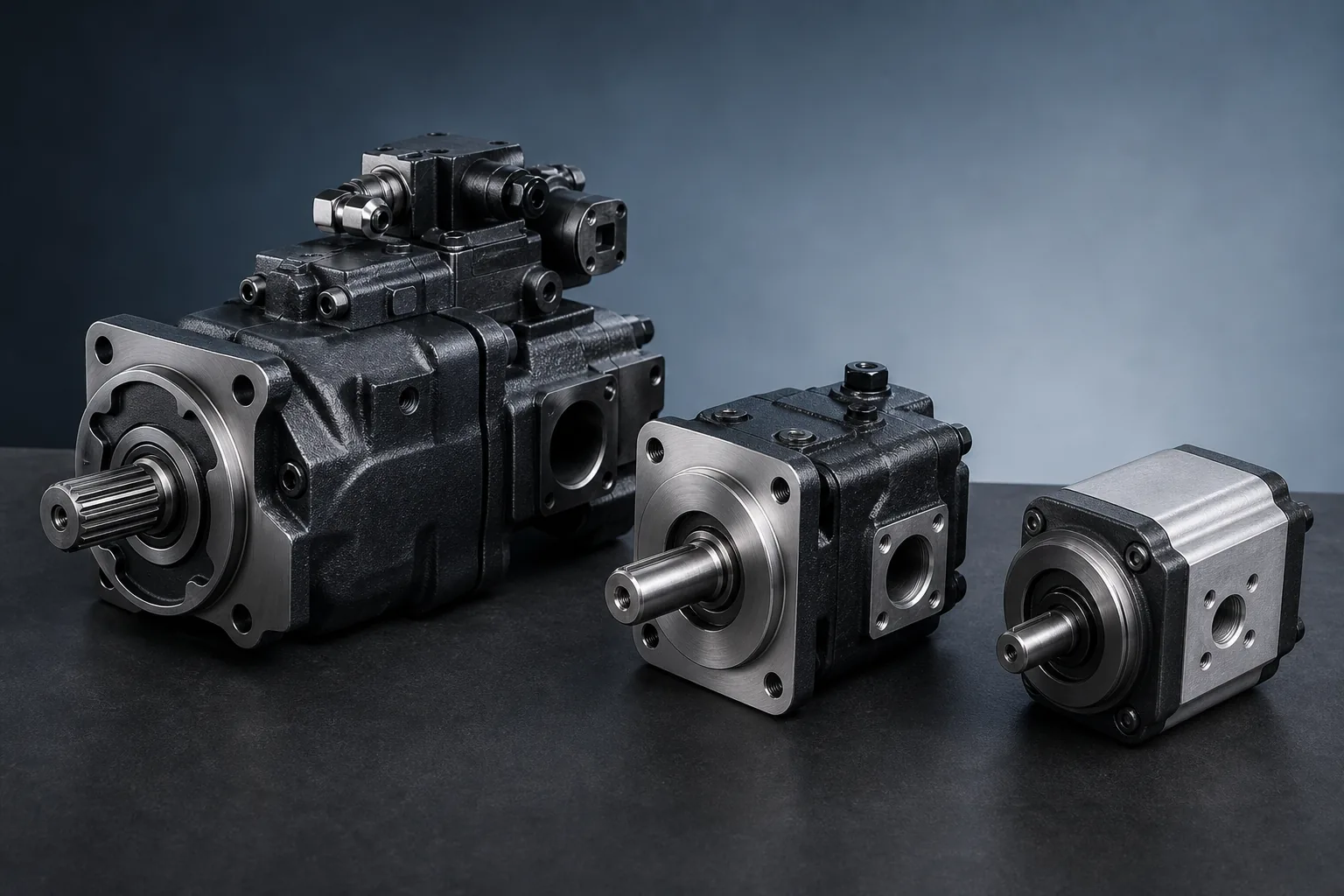
Send the original reference: Include the complete model code, quantity, destination and available photos or drawings.
Photographs to collect
- Full nameplate straight-on
- Shaft and mounting flange
- Port side and connection layout
- Control or compensator assembly
- Overall installation and drive arrangement
Technical information
- Complete model code and serial number
- Displacement and working pressure
- Direction of rotation
- Shaft type and flange
- Port threads and position
- Machine, fluid and duty cycle
Common identification errors
- Reading only the series name
- Assuming rotation from hose position
- Ignoring through-drive or control suffixes
- Measuring a worn shaft without reference data
Pump evidence matrix
| Evidence | What it can confirm | What it cannot confirm alone |
|---|---|---|
| Nameplate | Family, nominal displacement, control and configuration code | Current condition, hidden installation changes or unreadable suffixes |
| Shaft and flange photos | Interface type, pilot, bolt pattern and available clearance | Exact dimensions without a scale or drawing |
| Port-side photo | Port arrangement, control location and hose routing | Thread standard or internal control logic by appearance |
| Machine and duty data | Required pressure, flow, speed and control behavior | Exact original pump build without identity evidence |
When the nameplate is unreadable
Do not select from appearance alone. Record casting marks, all stamped numbers, shaft and pilot dimensions, bolt pattern, port threads, rotation viewed from the drive shaft, control photographs and machine identity. The result should remain a conditional identification until dimensions and function are reconciled.
Rotation must be stated from a defined viewing direction. “Left” or “right” without the drive-shaft viewpoint is ambiguous.