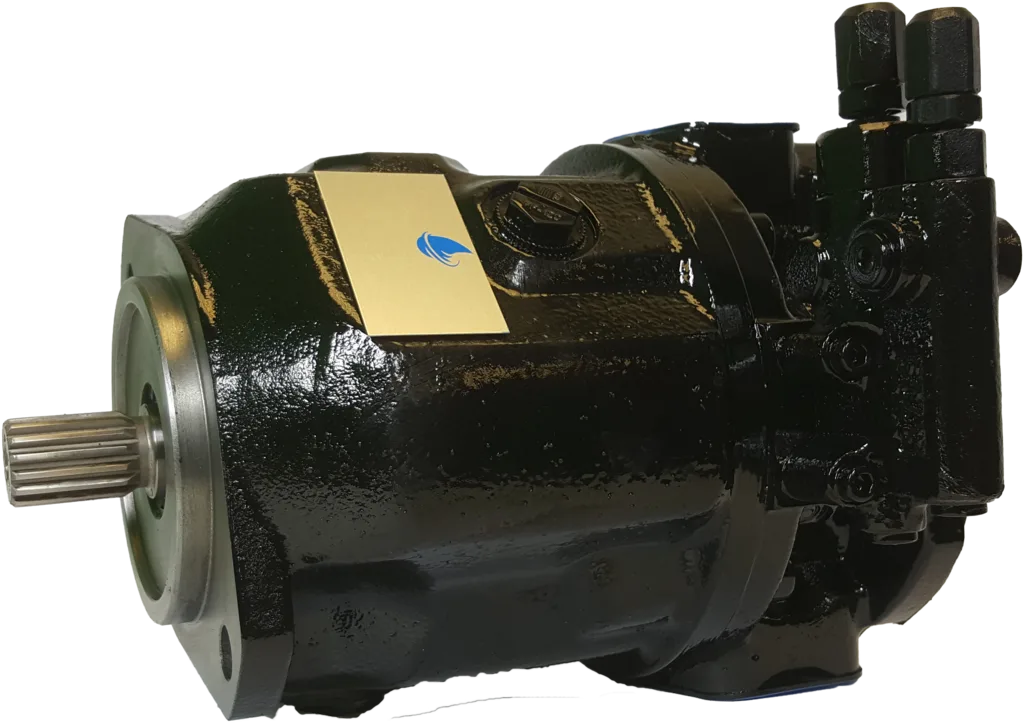
The Rexroth A10VSO is one of the most widely referenced open-circuit axial piston pumps in industrial and mobile hydraulic systems. A family name alone — 'A10VSO' — does not define the displacement, control, rotation, shaft, flange, ports or through-drive arrangement. This guide explains the comparison fields that must be checked before a Chinese-sourced alternative can be approved.
Send a hydraulic component for review: Include the complete model code, quantity, destination and available photos or drawings.
Why 'A10VSO' is not a purchase specification
The A10VSO family spans multiple displacements, control options, rotations, shaft ends, flanges, port arrangements and through-drive configurations. Selecting by the short series name risks an installation or performance mismatch.
- Displacements range from 18 to 140 cm³/rev across the family
- Control options include pressure compensator (DR), load sensing (DFR), remote pressure (DRG), electronic (EP) and others
- Rotation can be clockwise or counter-clockwise — and the convention matters
- Shaft options include keyed, splined and multiple diameters
- Flange choices include ISO 2-bolt and 4-bolt patterns
- Port orientation, through-drive and auxiliary options are encoded in the full type code
Complete comparison checklist
| Parameter | Original A10VSO data needed | Release condition |
|---|---|---|
| Displacement | Nominal cm³/rev from the nameplate code | Candidate matches displacement and permissible speed range |
| Pressure | Working and peak pressure from the machine specification | Candidate rating covers the application with appropriate margin |
| Control | Complete control code: DR, DFR, DRG, EP, etc. | Control behaviour, setting range and response are confirmed by supplier data |
| Rotation | As viewed from the drive shaft per the manufacturer convention | Rotation is confirmed by nameplate marking and supplier specification |
| Shaft | Type, diameter, key/spline detail and length | Supplier drawing or measured dimensions match the original |
| Flange | Pilot diameter, bolt pattern, bolt circle and bolt size | Mounting dimensions are confirmed by supplier drawing |
| Ports | Main pressure, suction and case-drain port sizes, types and positions | Every connection point is mapped against the original installation |
| Through-drive | Rear auxiliary pump interface specification, if present | Through-drive availability and rating are confirmed or explicitly excluded |
| Seals | Material (NBR / FKM) and temperature range | Seal material matches the fluid and operating temperature |
Common A10VSO sourcing pitfalls
- A supplier offers 'A10VSO' without asking for the complete type code — the quotation may overlook critical suffixes
- Two pumps share the same displacement and flange but use opposite rotations
- A pressure compensator setting is assumed rather than confirmed from the machine specification
- The original through-drive auxiliary pump is forgotten — the replacement pump lacks the rear pad
- Port threads are guessed from nominal size rather than verified from the original installation
- The seal material cannot handle the actual fluid temperature or type
The most expensive mistakes are the ones the supplier did not ask about and the buyer did not know to check.
Application data that changes the comparison
Beyond the pump code, the machine application affects whether a proposed option is acceptable.
- Machine type, function and duty cycle — continuous, intermittent or standby
- Working pressure profile — steady or with frequent peaks
- Hydraulic fluid type, viscosity and normal operating temperature
- Prime mover speed and drive arrangement
- System cooling and filtration condition
- Reason for replacement — wear, damage, upgrade or preventive maintenance
Sample and commissioning plan
For a first order or a higher-risk machine, a controlled sample before batch purchase is a prudent step.
- Define the sample quantity, acceptance criteria and approval authority before ordering
- Record the original pump settings and machine performance baseline before removal
- Commission the sample pump at reduced pressure/speed where possible
- Monitor case-drain flow, operating temperature, noise and machine cycle time
- Document the result — pass, conditional acceptance with noted deviations, or reject
- Only proceed to batch when the sample evaluation is complete and approved
Related Articles
How to Source Hydraulic Pumps from China: A Practical Guide
A step-by-step guide for hydraulic distributors, repair shops and MRO buyers sourcing piston, vane and gear pumps from China — covering model codes, supplier screening and pre-shipment checks.
Read article →How to Decode a Rexroth or Vickers Hydraulic Valve Model Code
Learn how to read Rexroth 4WE, Vickers DG4V and similar hydraulic directional valve model codes. Each code group controls function, voltage, mounting and seals.
Read article →