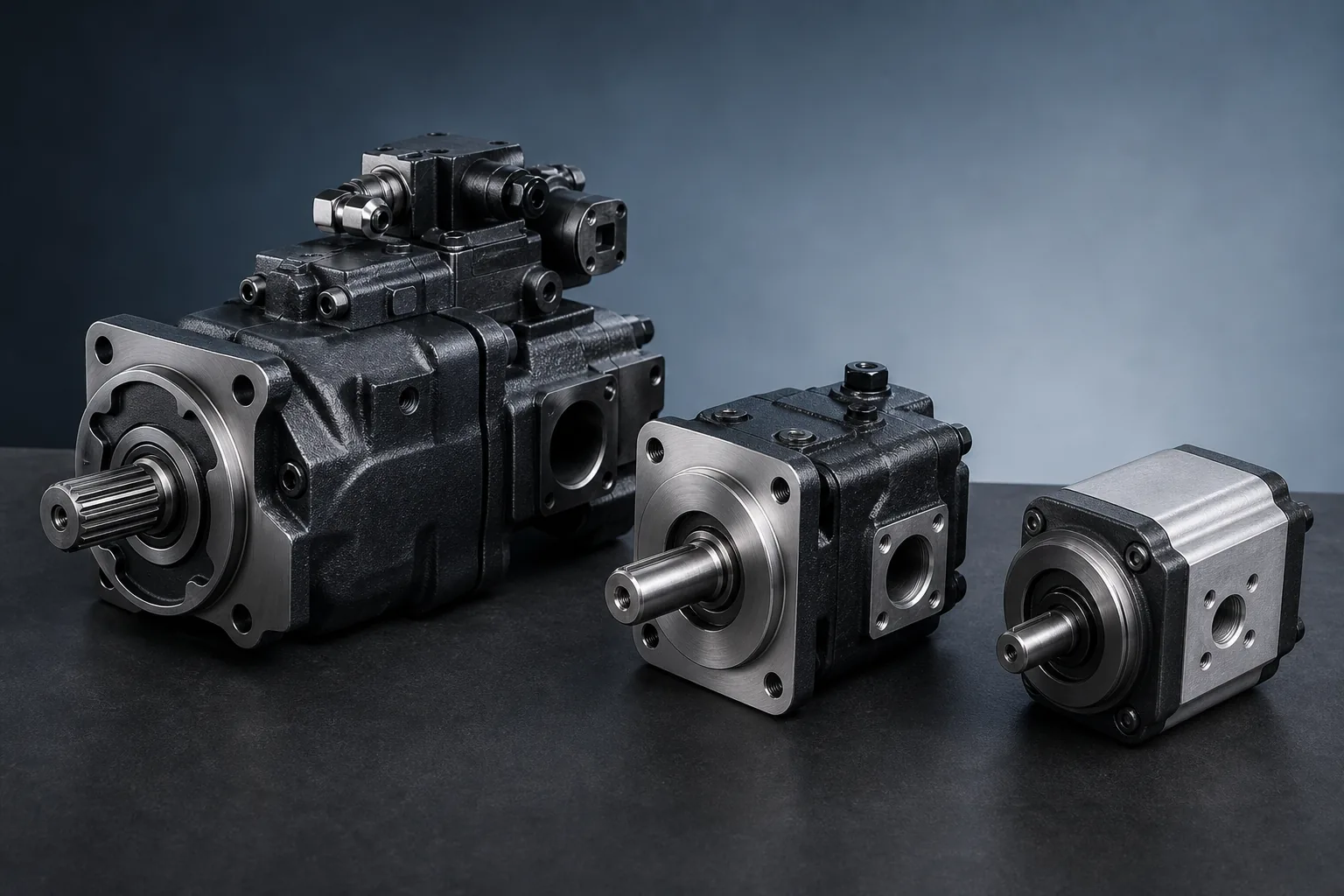
The first pump decision is usually fixed or variable displacement. The two families change how the circuit produces and controls flow, so the choice belongs to the application, not to habit.
Send a hydraulic component for review: Include the complete model code, quantity, destination and available photos or drawings.
What the names mean
- A fixed displacement pump delivers a nominal flow per revolution set by its size
- A variable displacement pump changes output flow through a swashplate, yoke or similar control
- Gear pumps are normally fixed; axial piston and vane families exist in both versions
Where each fits
| Consideration | Fixed displacement | Variable displacement |
|---|---|---|
| Circuit need | Steady flow, simple control | Flow changes with demand |
| Energy use | Relief valve bypass wastes energy | Pump output follows demand |
| Complexity | Simpler, lower cost | Control, drain and compensation complexity |
| Typical use | Presses, simple cylinders, low-cost drives | Load sensing, mobile, multi-function machines |
Control options that matter
- Pressure compensation limits maximum pressure while allowing flow reduction
- Load sensing matches flow to the highest working pressure and demand
- Electrical proportional control supports programmable machine behaviour
- The complete model code defines which control and its adjustment range apply
Before quoting a replacement
- Confirm the existing control type, displacement range and maximum pressure
- Record rotation, shaft, flange, ports and through-drive
- Note the machine duty cycle and whether the control is load-sensing
- Send the nameplate and control photographs with the inquiry